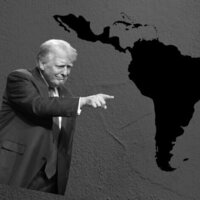


With the Trump imperium passing the half-year mark, the posture of the US empire is ever clearer. Whether animated by America First or globalism, the objective remainsfull spectrum dominance. And now with theneocon captureof the Democrats, there are no guardrails from the so-called opposition party.
By Roger D. Harris and John Perry
Call it thenew cold war, thebeginning of World War III, or in Trumps wordsendless war, this is the era that the world has entered. The US/Zionist war against Iran has paused, but no one has any illusions that it is over. And it wont likely be resolved until one side decisively and totally prevails. Ditto for the proxy war with Russia in Ukraine. Likely the same with Palestine, where the barbarity of war worsened to genocide. Meanwhile, since Obamas pivot to Asia, the empire is building up forwar with China.
In Latin America and the Caribbean, the empires war on the world assumes a hybrid form. The carnage is less apparent because the weapons take the form of soft powersanctions, tariffs, and deportations. These can have the same lethal consequences as bombs, only less overt.
Making the world unsafe for socialism
Some Western leftists vilify the defensive measures that Cuba, Venezuela and Nicaragua must take to protect themselves from the empires regime-change schemes. In contrast, Washington clearly understands that these countries pose threats of a good example to the empire. Each subsequent US president, from Obama on, has certified them as extraordinary threats to US national security. Accordingly, they are targeted with the harshest coercive measures.
In this war of attrition, historian Isaac Saneyusesthe example of Cuba to show how any misstep by the revolutionary government or deficiency within society is exaggerated and weaponized. The empires siege, he explains, is not merely an attempt to destabilize the economy but is a deliberate strategy of suffocation. The empires aim is to incite internal discontent, distort peoples image of the government, and ultimately dismantle social gains.
While Cuba is affected worst by the hybrid war, both Venezuela and Nicaragua have also been damaged. All three countries have seen humanitarian parole for their migrants in the US ended. Temporary Protected Status (TPS) was also withdrawn for Venezuelans and Nicaraguans. The strain of returning migrants along with cuts in the remittances they had sent (amounting to a quarter of Nicaraguas GDP) further impact their respective economies.
Higher-than-average tariffs are threatened on Venezuelan and Nicaraguan exports to the US, together with severe restrictions on Caracass oil exports. Meanwhile, the screws have been tightened on thesix-decadeUS blockade of Cuba with disastrous humanitarian consequences.
However, all three countries are fighting back. They are forming new trade alliances with China and elsewhere. Providing relief to Cuba, Mexico has supplied oil and China is installing solar panel farms to address the now daily losses of electrical power. High levels of food security in Venezuela and Nicaragua have strengthened their ability to resist US sanctions, while Caracas successfully defeated one of Washingtons harshest migration measures by securing the release of 252 of its citizens who had been incarcerated in El SalvadorstorturousCECOT prison.
Venezuelas US-backed far-right opposition is in disarray. The first Trump administration had recognized the interim presidency of Juan Guaid, followed by the Biden administration declaring Edmundo Gonzlez winner of Venezuelas last presidential election. But the current Trump administration has yet to back Gonzlez, de facto recognizing Venezuelan President Nicols Maduro.
Nicaraguas right-wing opposition is also reeling from a side-effect of Trumps harsh treatment of migrants many are returning voluntarily to a country claimed by the opposition to be unsafe, while US Homeland Security has evenextolledtheir home countrys recent achievements. And some of Trumps prominent Cuban-American supporters are nowquestioninghis maximum pressure campaign for going too far.
Troubled waters for the Pink Tide
The current progressive wave, the so-called Pink Tide, was initiated by Mexican President Andrs Manuel Lpez Obradors landslide victory in 2018. His MORENA Party successor, Claudia Sheinbaum, won by an even greater margin in 2024. Mexicos first woman president has proven to be perhaps the worlds most dignified and capable sparring partner with the buffoon in White House, who has threatened tariffs, deportations, military interdictions and more on his southern neighbor.
Left-leaning presidents GabrielBoric in Chile and Gustavo Petro in Colombia are limited to single terms. Both have faced opposition-aligned legislatures and deep-rooted reactionary power blocs. Chilean Communist Party candidate Jeanette Jara is favored to make it through their first-round presidential election in November 2025, but will face a challenging final round if the right unifies, as is likely, around an extremist candidate.
As the first non-rightist in Colombias history, Petro has had a tumultuous presidential tenure. He credibly accuses his former foreign minister ofcolludingwith the US to overthrow him. However, the presidency could well revert to the right in the May 2026 elections.
Boric, Petro, Uruguays Yamand Orsi and Brazils Luiz Incio Lula da Silvamet in Julyas the regions center-left presidents, with an agenda of dealing with Trump, promoting multilateralism and (we can assume) keeping their distance from the regions more left-wing governments.
With shaky popularity ratings, Lula will likely run for reelection in October 2026. As head of the regions largest economy, Lula plays a world leadership role, chairing three global summits in a year. Yet with less than majority legislative backing, Lula has triangulated between Washington and the Global South, often capitulating to US interests (as in his veto of BRICS membership for Nicaragua and Venezuela). Regardless, Trump is threatening Brazil with a crippling 50% export tariff and is blatantly interfering in the trial of former right-wing President Jair Bolsonaro, accused of insurrection. So far, Trumps actions have backfired, arousing anger among Brazilians. Lulacommentedthat Trump was not elected to be emperor of the world.
In 2021, Honduran President XiomaraCastro took over anarcostatesubservient to Washington and has tried to push the envelope to the left. Being constitutionally restricted to one term, Castro hands the Libre party candidacy in Novembers election to former defense minister Rixi Moncada who faces atough contestwith persistentUS interference.
Bolivias ruling Movement Toward Socialism (MAS) Party is locked in a self-destructive internecine clash between former President Evo Morales and his ex-protg and current President Luis Arce. The energized Bolivian rightwing is spoiling for the August 17th presidential election.
Israeli infiltration accompanies US military penetration
Analyst Joe Emersbergernotes: Today, all geopolitics relates back to Gaza where the imperial order has been unmasked like never before.DefyingWashington, theHague Groupmet in Colombia for an emergency summit on Gaza to take collective action grounded in international law. On July 16, regional states Bolivia, Cuba, Colombia, Nicaragua and Saint Vincent and the Grenadines endorsed the pledge to take measures in support of Palestine, with others likely to follow. Brazil will join South Africas ICJ complaint against Israel.
At the other end of the political spectrum are self-described worlds coolest dictator Nayib Bukele ofEl Salvadorand confederates Javier Milei of Argentina and Daniel Noboa of Ecuador. As well as cozying up to Trump, they devotedly support Israel, which has beeninstrumentalin enabling the most brutal reactionaries in the region. Noboa dulytellsIsraels Netanyahu that they share the same enemies.
In February, the US Southern Commandwarned: Time is not on our side. The perceived danger is methodical incursion into our neighborhood by both Russia and China. Indeed, China has become the regionssecond-largesttrading partner after the US, and even right-wing governments are reluctant to jeopardize their relations with Beijing. The empires solution is to redouble our efforts to nest military engagement, using humanitarian assistance as an essential soft power tool.
Picking up where Biden left off, Trump has furthered USmilitary penetration, notably in Ecuador,Guyana,Brazil,Panama, and Argentina. The pandemic ofnarcotics trafficking, itself a product ofUS-induceddemand, has been a Trojan Horse for militarist US intervention in Haiti, Ecuador, Peru, and threatened in Mexico.
In Panama, President Jos Mulinos obeisance to Trumps ambitions to control the Panama Canal and reduce Chinas influenceprovokedmassive protests. Trumps collaboration in the genocide of Palestinians motivated Petro todeclarethat Colombia must leave the NATO alliance and keep its distance from militaries that drop bombs on children. Colombia had been collaborating with NATO since 2013 and became the only Latin American global partner in 2017.
Despite Trumps bluster what the Financial Times callsimperial incontinencehis administration has produced mixed results. While rightist political movements have basked in Trumps fitful praise, his escalating coercion provokes resentment against Yankee influence. Resistance is growing, with new alliances bypassing Washington. As the empires grip tightens, so too does the resolve of those determined to break free from it.
Roger D. Harrisis with theTask Force on the Americas, theUS Peace Council, and theVenezuela Solidarity Network. Nicaragua-based
John Perryis with theNicaragua Solidarity Coalitionand writes for MR Online, the London Review of Books, FAIR and CovertAction, among others.
Pressenza New York